LASIK vs ICL
LASIK and ICL can both reduce dependence on glasses or contacts, but they are not interchangeable. For stronger prescriptions, thin corneas, or certain eye measurements, one option may fit better than the other — and many people are not good candidates for either after a real exam.
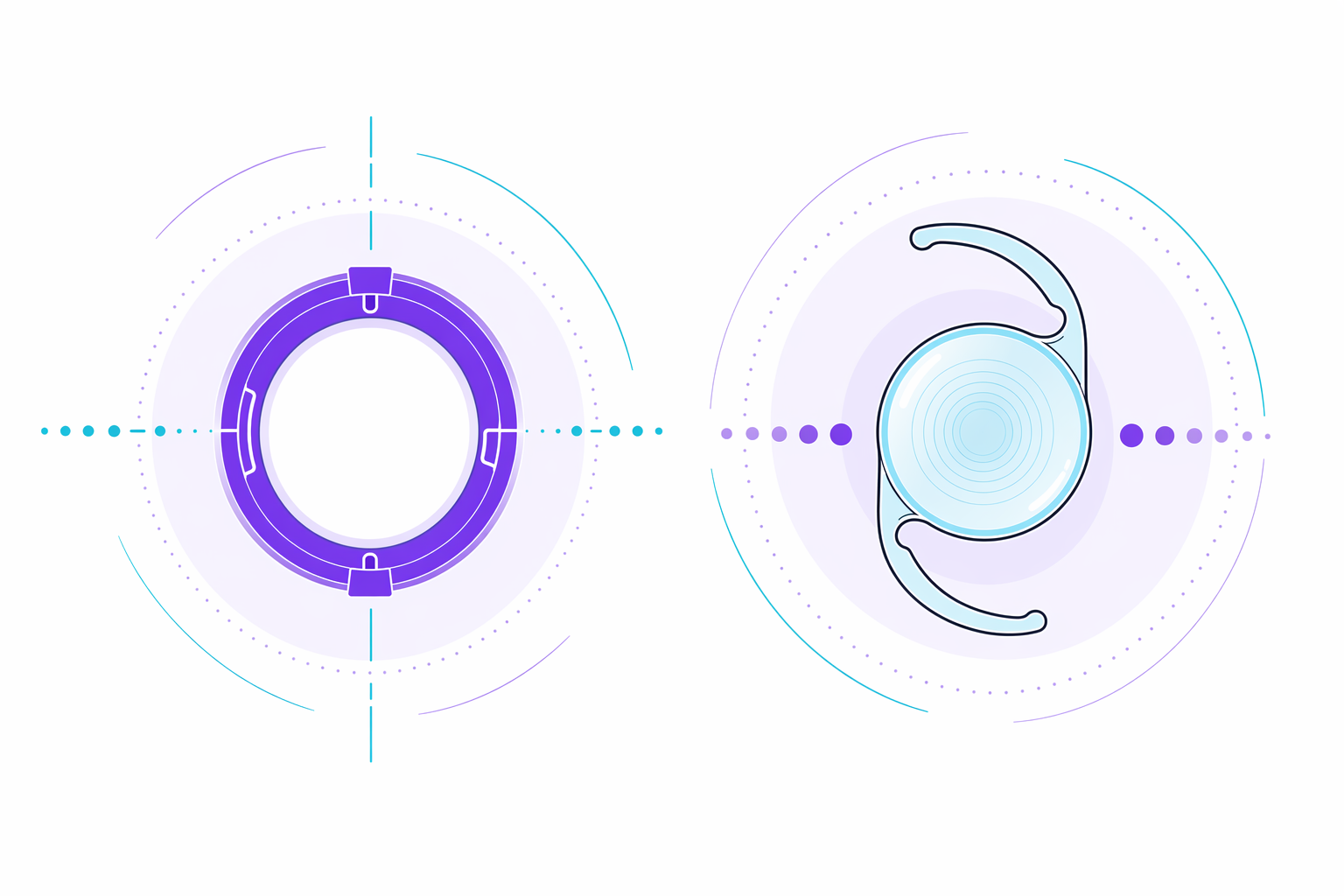
The short version: how LASIK and ICL differ
LASIK reshapes the cornea with a laser. The surgeon creates a flap, changes the cornea's shape, and puts the flap back. It is often discussed for nearsightedness, farsightedness, and astigmatism, but there are treatment limits. If your prescription is very strong, or your cornea is too thin or irregular, LASIK may not be a safe or sensible choice. You can read more about the procedure at LASIK.
ICL stands for implantable collamer lens. Instead of reshaping the cornea, a surgeon places a lens inside the eye, usually behind the iris and in front of the eye's natural lens. It is often considered for moderate to high nearsightedness, sometimes with astigmatism depending on the lens option and the eye.
For people with high prescriptions, the basic idea is simple:
- LASIK removes tissue from the cornea.
- ICL adds a lens inside the eye.
- If removing too much corneal tissue would be unsafe, LASIK may be ruled out.
- If the inside of the eye does not have enough space for an ICL, or other measurements are not suitable, ICL may be ruled out.
That is why ads and online calculators can only go so far. Only a licensed eye surgeon, after an in-person exam, can tell you whether either option is appropriate for your eyes. Sightlume is a free matching service. We help you understand the choices and connect with licensed ophthalmologists for consultations. We do not do exams, diagnose, or recommend surgery.
When high prescriptions change the conversation
If you have a stronger prescription, the question is usually not just, "Which one sounds better?" It is more often, "What is still within safe treatment limits for my eyes?"
A surgeon may look at LASIK more cautiously when:
- your nearsightedness or astigmatism is high
- your corneas are thin
- your corneal shape looks uneven or suspicious
- removing enough tissue could leave the cornea too weak
- your prescription has not been stable
A surgeon may consider ICL when:
- your prescription is outside or near the upper end of what corneal laser surgery may safely treat
- your corneas are too thin for LASIK
- you have dry eye concerns and want to discuss options that do not reshape the cornea
- the anatomy inside your eye appears suitable for a lens implant
But ICL is not a "better LASIK" for everyone. It is a different surgery with its own tradeoffs. It usually involves a higher upfront cost. It also places a lens inside the eye, so surgeons need to check things LASIK patients may never think about, such as the depth and space in the front part of the eye and the health of internal structures.
If you are not sure where you fit, start with the basics on candidacy and the exam. The exam matters more than the marketing.
Pros, limits, and real risks of each option
It helps to compare the upside and the downside honestly.
LASIK: common reasons people ask about it
- widely known procedure
- short treatment time
- often fast visual recovery for many patients
- no lens implanted inside the eye
LASIK: important limits and risks
- not everyone is a candidate
- high prescriptions may require removing too much corneal tissue
- dry eye can happen or get worse
- glare, halos, starbursts, and night-driving problems can happen
- under-correction or over-correction can happen
- flap complications are possible
- infection is uncommon but real
- rare loss of vision is possible
ICL: common reasons people ask about it
- often discussed for moderate to high nearsightedness
- may be an option when the cornea is too thin for LASIK
- does not remove corneal tissue
ICL: important limits and risks
- higher cost than LASIK in many markets
- not everyone has the right eye anatomy for it
- because a lens is placed inside the eye, there are lens-specific risks to discuss
- glare and halos can still happen
- pressure issues, inflammation, infection, cataract formation, or lens position problems can occur in some cases
- an additional procedure may be needed in some situations
- rare vision-threatening complications are possible
Neither option comes with a guarantee. Results vary from person to person. Some people still need glasses for certain tasks after surgery. Some need an enhancement or future treatment. Some decide the risks are not worth it and keep glasses or contacts. That is a valid choice.
For a plain-language review of surgical downsides that ads often rush past, see LASIK risks and side effects. Even if you end up leaning toward ICL, it helps to learn how honest surgeons talk about risk.
What to do before you compare consultations
Do these steps before you get attached to one procedure name.
1. Know your goal.
Are you trying to reduce thick glasses? Improve sports or work convenience? Avoid contact lenses? Your goal helps frame the conversation.
2. Bring your recent prescription, but do not assume it answers the question.
A glasses or contact lens prescription is useful, but it does not show corneal thickness, shape, tear film, pupil behavior, or internal eye measurements.
3. Ask each surgeon the same few questions.
- Am I a candidate for LASIK, ICL, both, or neither?
- If you say no to one option, what exam findings are driving that decision?
- What risks matter most in my case?
- What is the realistic chance I may still need glasses sometimes?
- What follow-up care is included, and what is not?
4. Compare cost honestly.
Typical US ranges are about $2,000-$3,000 per eye for LASIK and $3,000-$5,000 per eye for ICL. Both eyes are roughly double. These are estimates, not quotes. The real price depends on the procedure, your eyes, the technology used, and where you live. Surgery is rarely covered by insurance. You can review general price ranges at costs.
5. Take your time.
If one consultation feels rushed, sales-heavy, or vague about risk, that is useful information.
Sightlume can help you get matched with licensed ophthalmologists near you for consultations, including help for people who prefer a language other than English. The matching is free to you. You choose who to contact and who to trust.
Common mistakes people make when choosing between LASIK and ICL
A few mistakes come up again and again.
- Thinking high prescription automatically means ICL. Sometimes yes, sometimes no, sometimes neither. The exam decides.
- Focusing only on price. Lower cost does not always mean better value if the option is a poor fit for your eyes. Higher cost does not mean safer or better either.
- Assuming recovery stories online will match your experience. They may not. Healing and results vary.
- Ignoring dry eye, night vision symptoms, or corneal measurements. These details matter.
- Treating a screening quiz like a medical answer. Online tools are not the same as an in-person exam.
- Feeling pressured to book surgery fast. A careful surgeon should be comfortable answering questions and, when needed, saying you are not a candidate.
A good consultation should leave you understanding why a surgeon recommends LASIK, ICL, another option such as PRK or SMILE, or no surgery at all. If you want help preparing for that conversation, our guide on how to choose an eye surgeon can help.
One last reminder: this page is general educational information, not medical advice. Sightlume is not a medical provider. Only a licensed eye surgeon, after an in-person exam, can tell you whether LASIK, ICL, another procedure, or no surgery is right for you.
If your prescription is high, LASIK may or may not still be safe, and ICL may or may not fit your eye anatomy. Do not guess from ads. Compare consultations, ask why a surgeon says yes or no, and remember that no one can tell you the right procedure without an in-person exam.